For many SMEs, revenue growth feels like the primary indicator of business success. But in reality, profitability—not revenue—is what keeps a business healthy and scalable. Profitability analysis helps you understand which customers, products, services, or regions actually contribute to your bottom line. When done right, it turns guesswork into a sharp decision-making system.
This guide walks you through simple yet powerful techniques to identify what truly drives profit in your business, so you can grow with clarity and confidence.
Why Profitability Analysis Matters
Most SMEs experience a common challenge: high sales but low margins. This happens when management focuses on topline growth without understanding the profitability of each business segment.
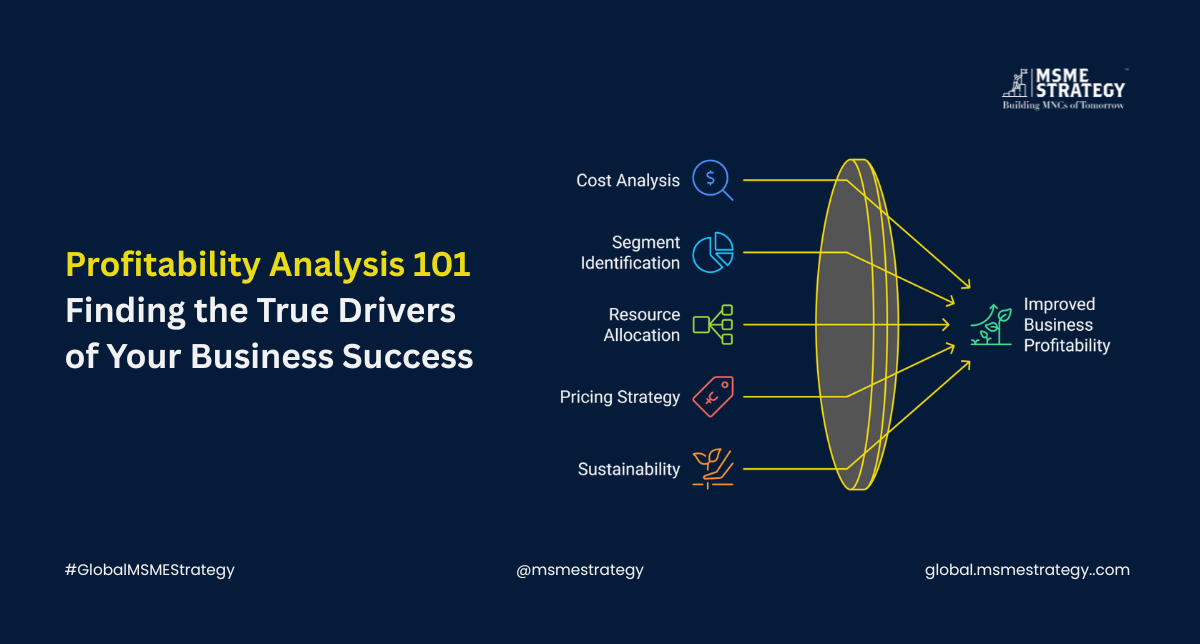
Profitability analysis helps you:
- Uncover hidden costs that reduce margins
- Identify high-profit and low-profit segments
- Allocate resources to the most profitable activities
- Improve pricing decisions based on true cost and value
- Strengthen long-term sustainability
Not all revenue is good revenue. Some sales create healthy cash flows; others drain your team, time, and capital. A structured approach helps you choose wisely.
1. Identify Your Profit Drivers
Every business has a few elements that disproportionately influence profits. These can be:
- Products/services with superior margins
- Customer segments that buy more frequently and require less support
- Sales channels with lower acquisition costs
- Regions/locations with stronger demand and better price realization
- Teams or processes that deliver high output at lower cost
Action Step: List your offerings and categorize them into high-margin, medium-margin, and low-margin buckets. You may discover that 20% of your portfolio generates 80% of your profit.
2. Calculate Contribution Margin
A simple but powerful tool, contribution margin tells you how much each product or service actually contributes to covering fixed costs and generating profit.
Formula:
Contribution Margin = Selling Price − Variable Cost
This helps SMEs compare offerings on a like-for-like basis. Even if two products have similar revenue, their profitability can differ widely.
Pro Tip: Track contribution margin monthly for your top-selling items. Trends often reveal early warning signs.
3. Evaluate Customer-Level Profitability
Not all customers are profitable—some require more discounts, support, or credit cycles than others.
Evaluate each customer on:
- Average order value
- Purchase frequency
- Payment discipline
- Support or service workload
- Returns or complaints
Once you know your high-profit customers, you can tailor marketing and retention strategies accordingly. For the low-profit ones, consider price revisions, stricter credit terms, or streamlined service processes.
4. Conduct a Cost-to-Serve Analysis
Cost-to-Serve (CTS) uncovers the true cost of serving each customer or segment.
Include:
- Delivery or logistics cost
- Customization work
- Post-sales service
- Time spent by sales or operations teams
- Packaging and special handling
A customer with high revenue but high CTS may actually reduce your MSME margins. Identifying such cases helps you redesign operations and negotiate smarter.
5. Identify Your “Profit Killers”
These often hide in plain sight:
- Loss-making SKUs kept for “completeness”
- High discounting during peak seasons
- Inefficient manual processes
- Poor pricing discipline
- Inventory sitting too long and eating working capital
Once identified, you can take corrective actions—automate tasks, remove low-performing SKUs, or reset pricing.
6. Use a Simple Profitability Dashboard
You don’t need complex software to start. A spreadsheet or an online tool can help you track:
- Revenue by product
- Margin % by product
- Margin by customer segment
- Cost-to-Serve
- Top and bottom 10 profit contributors
- Fixed vs variable cost trend
7. Make Profit-Focused Decisions
Once insights become visible, SMEs can:
- Prioritize profitable products and discontinue non-performers
- Redirect marketing budgets to high-profit customers
- Improve pricing models based on true cost data
- Reduce avoidable expenses through efficiency gains
- Align team incentives with profit outcomes—not just sales volume
Profitability analysis is not a one-time exercise. It becomes a strategic habit that guides every key decision.
For global SMEs, profitability is the compass that ensures sustainable growth. Instead of chasing volume, focus on understanding what truly creates value in your business. With simple analytical techniques and a clear view of your profit drivers, you can strengthen margins, improve resilience, and scale confidently.
About MSME Strategy Consultants
At MSME Strategy Consultants (global.msmestrategy.com), our experienced consultants partner with SMEs worldwide to identify growth opportunities, optimize resources, and future-proof operations.
MSME Strategy also gives you a comprehensive tool to diagnose your business and provides a detailed diagnostic report—absolutely free. Click here [link of the page] to get your customized report and uncover key insights for your growth.
Primary Hashtag:
#GlobalMSMEStrategy
Secondary Suggestions:
#Profitability #SMEMargins #MSMEStrategy #FinancialPerformance #BusinessGrowth #SustainableScaling #SMEProfits #DecisionMaking #BusinessAnalytics