Many SMEs reach a growth ceiling not because of market limitations, but because the business relies too heavily on the founder. When every decision, approval, and problem funnels through one individual, scale becomes fragile. A system-driven business replaces dependency with discipline-clear processes, defined roles, and repeatable execution that allow growth without constant founder intervention.
The Hidden Cost of Founder Dependence
Founder-led execution is often a strength in the early stages. However, over time it creates structural risk:
- Decision bottlenecks slow operations
- Teams wait for approvals instead of acting
- Quality fluctuates based on founder availability
- Expansion stalls because knowledge is not transferable
Reducing founder dependence is not about stepping away; it is about building systems that enable consistent outcomes.
What Does a System-Driven SME Look Like?
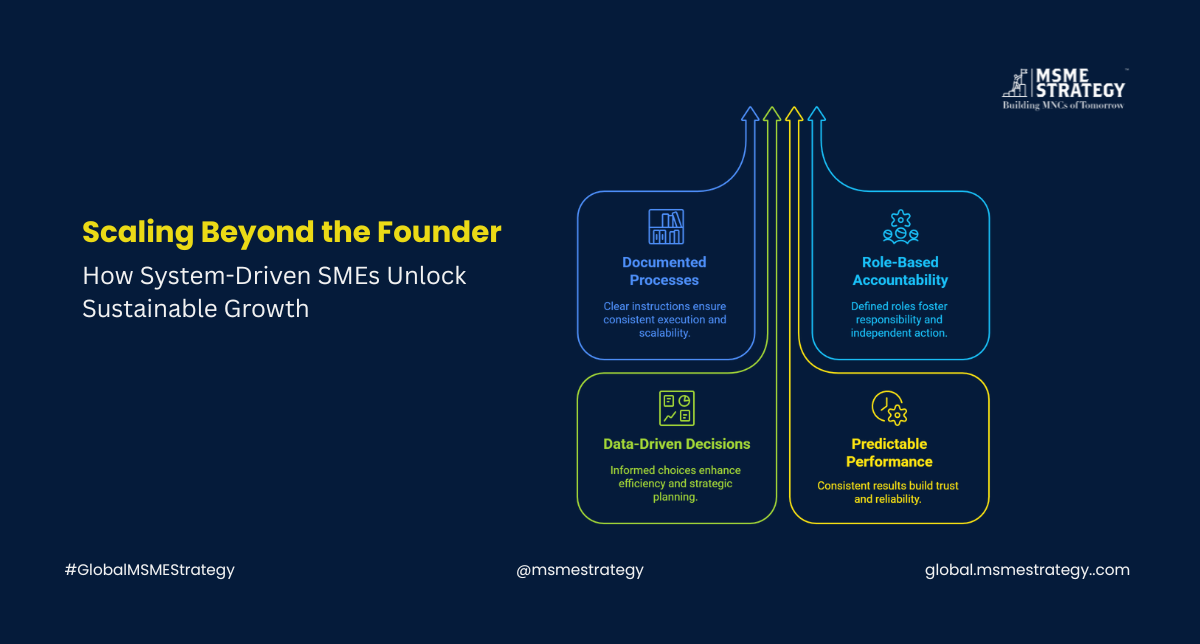
A system-driven SME operates on clarity rather than heroics. Its defining characteristics include:
- Documented processes instead of verbal instructions
- Role-based accountability rather than individual dependence
- Data-driven decisions instead of intuition alone
- Predictable performance across teams and locations
Such businesses scale faster because execution does not rely on memory, personality, or constant supervision.
Designing Processes That Scale
Effective process design focuses on simplicity and ownership, not bureaucracy.
1. Identify Founder-Centric Activities
Start by mapping tasks only the founder performs-pricing approvals, vendor negotiations, hiring decisions, or customer escalations. These are prime candidates for systemization.
2. Standardize Core Operations
Document repeatable workflows for critical functions such as sales, delivery, finance, and customer support. The goal is consistency, not rigidity.
3. Define Clear Decision Rights
Assign decision authority based on roles. When teams know what they can decide independently, speed and accountability improve.
4. Build Feedback Loops
Processes must evolve. Regular reviews using performance metrics ensure systems stay aligned with business goals.
Enabling Teams to Run the Business
Systems only work when people trust and use them.
- Train teams on “why” as well as “how”
- Use dashboards instead of constant reviews
- Shift the founder’s role from problem-solver to system-owner
This transition allows founders to focus on strategy, partnerships, and long-term growth.
The Strategic Payoff
System-driven SMEs are easier to scale, easier to delegate, and more resilient. They are also more attractive to investors and partners because the business can operate independently of any single individual. Reducing founder dependence is not an operational exercise-it is a strategic imperative.
About MSME Strategy Consultants
At MSME Strategy Consultants (global.msmestrategy.com), our experienced consultants partner with SMEs worldwide to identify growth opportunities, optimize resources, and future-proof operations.
MSME Strategy also gives you a comprehensive tool to diagnose your business and provides a detailed diagnostic report-absolutely free. Click here https://resources.msmestrategy.com/diagnose-my-business to get your customized report and uncover key insights for your growth.
#GlobalMSMEStrategy
#SystemDrivenSMEs #ReduceFounderDependence #ScalableOperations #SMEGrowth #BusinessProcessDesign #OperationalExcellence