For MSMEs across the world, sustainable growth rarely comes from working harder-it comes from working smarter through scalable frameworks. Businesses that rely on individual effort, ad-hoc decisions, or outdated systems struggle to expand beyond a point. But those built on strong, repeatable, and adaptive frameworks can grow consistently, enter new markets, and withstand economic shifts.
This article outlines a clear blueprint for SME owners and executives to build scalable operations that create long-term resilience and predictable expansion.
Why Scalable Frameworks Matter
Scalability ensures your business can handle more customers, more markets, and more operations without proportionally increasing cost or complexity.
When frameworks guide your workflows and decisions, you reduce dependency on individuals, improve efficiency, and achieve consistent quality-regardless of where or how fast you grow.
The Four Pillars of a Scalable MSME Framework
1. People: Build Capacity, Not Dependency
A scalable business is built on empowered teams with clear roles-not on a single individual who “knows everything.”
Key actions:
- Define clear responsibilities and decision boundaries.
- Implement structured onboarding and continuous learning programs.
- Create a leadership pipeline for future expansion.
- Establish performance systems tied to outcomes, not hours.
A people framework strengthens accountability and ensures the business can grow without constant top-level supervision.
2. Process: Standardize for Consistency and Speed
Processes are the backbone of scale. Without standardization, growth amplifies chaos-not profits.
Key actions:
- Document core workflows across sales, finance, procurement, and production.
- Automate repetitive tasks and decision-making through SOPs.
- Introduce cross-functional process maps to reduce bottlenecks.
- Set measurable KPIs to monitor process efficiency.
When processes run smoothly, every new location, customer segment, or product line becomes easier to manage.
3. Technology: Build a Future-Ready Digital Infrastructure
Technology is no longer optional-it is the multiplier that enables scale. Outdated systems slow down expansion and increase operational risks.
Key actions:
- Adopt cloud-based tools for CRM, ERP, HRMS, and financial management.
- Leverage data analytics for forecasting, benchmarking, and customer insights.
- Integrate systems to avoid manual duplication and errors.
- Choose scalable platforms that grow with your business, not limit it.
Digitization enhances transparency, speeds up operations, and strengthens decision-making.
4. Capital: Structure Finance to Support Growth
Scaling requires disciplined financial planning-not just funding.
Key actions:
- Develop a 3–5 year capital roadmap aligned to business priorities.
- Maintain strong financial hygiene-accurate books, compliance, cash flow controls.
- Explore blended financing: equity, debt, government schemes, and internal accruals.
- Build investor-ready documentation for future expansion opportunities.
Capital frameworks ensure that growth plans are financially attainable and sustainable.
A High-Level Blueprint to Scale
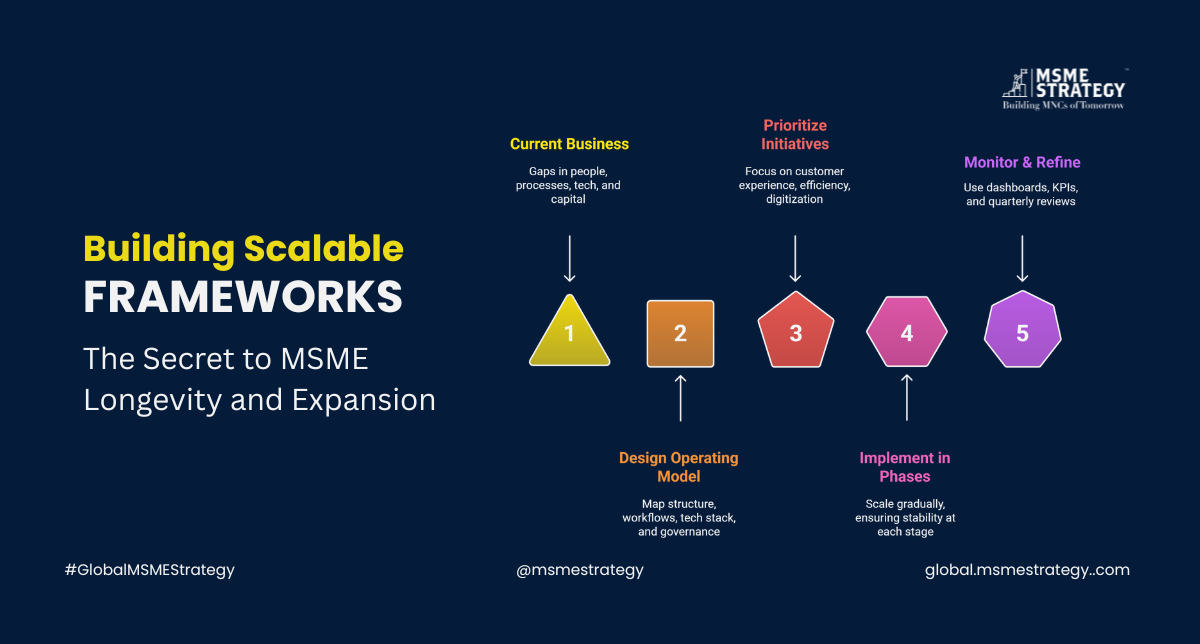
To build a scalable MSME, evaluate your business through this sequence:
- Diagnose the business – Identify gaps across people, processes, tech, and capital.
- Design a scalable operating model – Map structure, workflows, tech stack, and governance.
- Prioritize initiatives – Start with high-impact areas: customer experience, efficiency, digitization.
- Implement in phases – Scale gradually, ensuring stability at each stage.
- Monitor, measure, and refine – Use dashboards, KPIs, and quarterly reviews.
This systematic approach ensures that growth is strategic, repeatable, and resilient across global markets.
Scalable frameworks are not just tools—they are the foundation of long-term MSME success. Whether you’re planning international expansion, diversifying offerings, or strengthening internal efficiency, these four pillars help ensure that your business grows at the right pace and remains competitive in an increasingly digital world.
About MSME Strategy Consultants
At MSME Strategy Consultants (global.msmestrategy.com), our experienced consultants partner with SMEs worldwide to identify growth opportunities, optimize resources, and future-proof operations.
MSME Strategy also gives you a comprehensive tool to diagnose your business and provides a detailed diagnostic report-absolutely free. Click here https://resources.msmestrategy.com/diagnose-my-business to get your customized report and uncover key insights for your growth.
#GlobalMSMEStrategy #MSMEGrowth #ScalableBusinessFrameworks #SMELeadership #BusinessSystems #OperationalExcellence #DigitalTransformation #SMEExpansion